Today’s venues are programmable assets—expected to generate revenue, host multiple sports and events, adapt overnight and produce content that travels well beyond the building.
In 2026, sports branding trends reflect that pressure directly. Partnership teams are under real strain to grow revenue from the same square footage of their venue.
Fans document everything and share it instantly. The in-venue experience is now measured against a highlight reel—and static, outdated environments don’t hold up. This article covers six sports branding trends shaping how venues are being upgraded and activated right now.
What Are the Top Sports Branding Trends for Venues in 2026?
Branding trends for sports venues in 2026 center on flexibility, sponsorship monetization, social-first visual design, immersive fan experience and inclusive wayfinding. Venues are investing in graphic systems that reconfigure quickly, rotate sponsor messaging and hold up as content across both broadcast and mobile platforms.
The six sports branding trends below define what that investment looks like in practice—from field-level graphics to concourse activations to wayfinding systems.
Multipurpose Graphics for Venues Hosting Multiple Sports and Events
Venues hosting multiple sports—or mixing sports with concerts and non-sporting events—need graphic systems that can fully reconfigure between uses in hours, not weeks.
DUAL-SPORTS STADIUMS
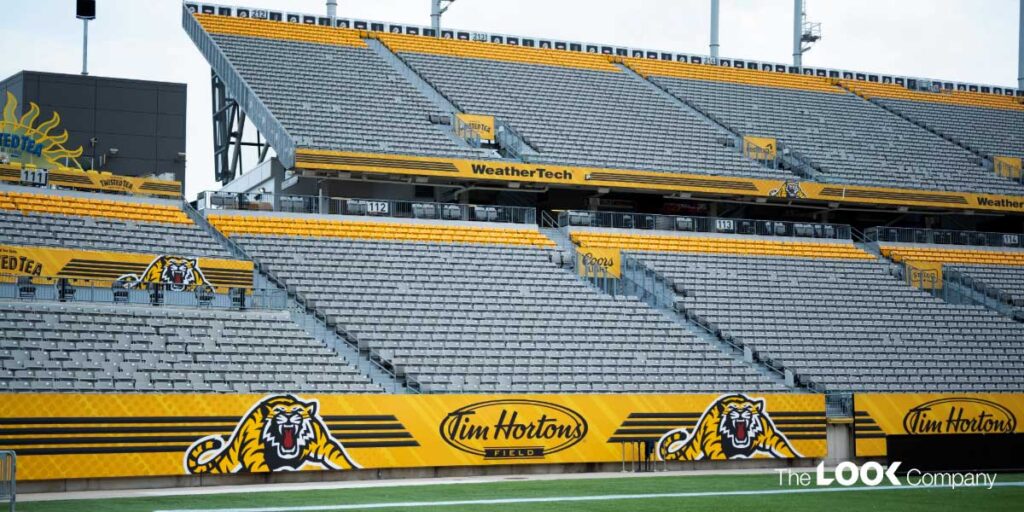
Dual-sport buildings like Tim Hortons Field, home to both the Hamilton Tiger-Cats of the CFL and Forge FC of the Canadian Premier League, can’t rely on sport-specific installs. The Look Company worked with the Tim Hortons Field operations team to develop a full changeout solution: fabric prints installed over the Tiger-Cats’ graphics and zip-tied for Forge FC games, then removed and stored on transportable rollers.
Custom printed seat covers handle sections not in use—keeping the environment tight and on-brand for each team.
COLLEGE AND UNIVERSITY FACILITIES
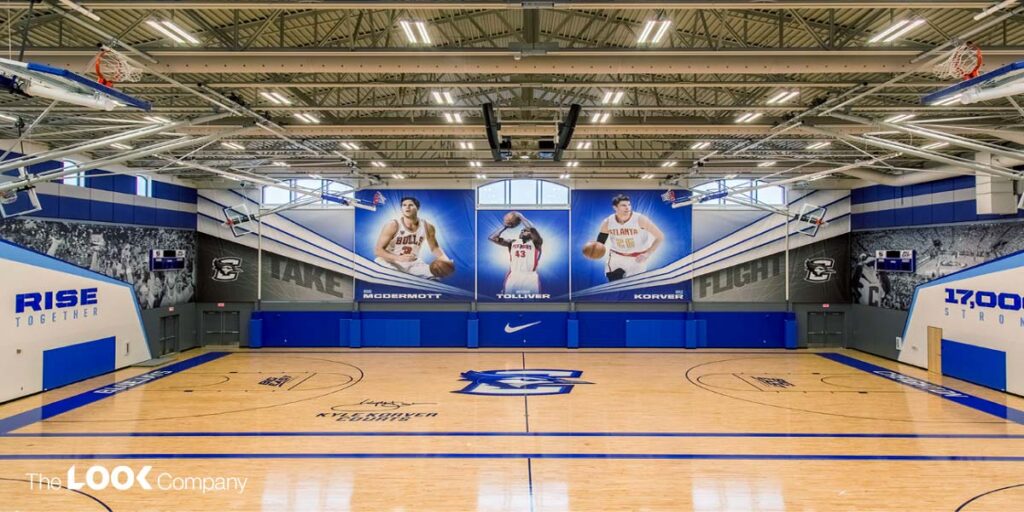
The college and university market is among the heaviest investors in flexible graphic systems—athletic departments running football, basketball and non-sport events in the same building are driving real demand, fueled by recruiting competition and donor expectations.
CONCERTS AND EXTERNAL EVENTS
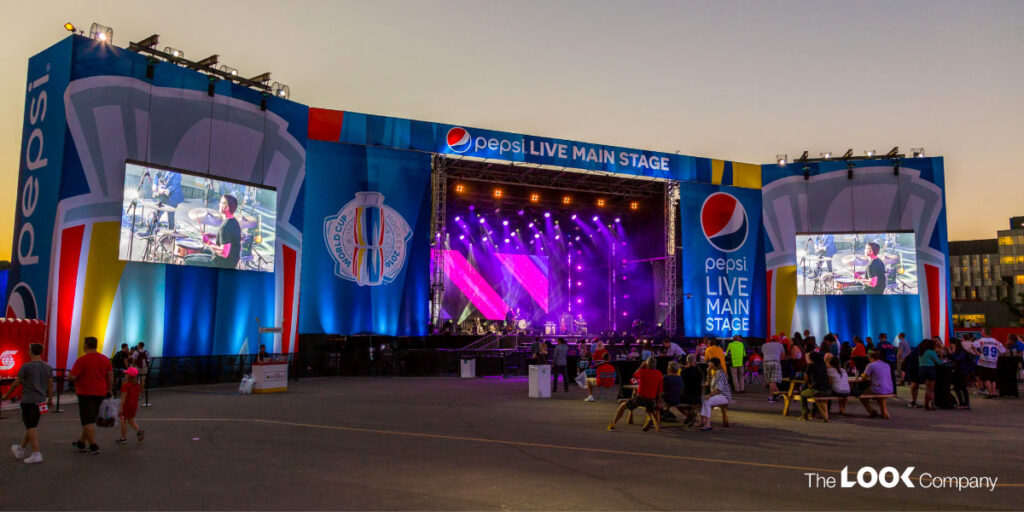
For concerts and external events, temporary graphic placement—across scaffolding, staging and perimeter fencing—allows full visual activation without touching permanent installs.
Strategic takeaway: Audit which graphic installations are event-agnostic and which are locked to a single sport. Prioritize converting fixed installs to flexible systems where turnaround time is a constraint.
Rotating Sponsorships Through a Single Physical Space
Sponsorship volume and deal complexity are growing—but the physical footprint hasn’t changed. Teams are responding by restructuring in-venue graphics so one wall, panel or banner can carry multiple brands across a game, series or season.
This is driving demand for sponsor rotation systems—graphic hardware designed to accommodate regular brand changeovers, with substrates and mounting systems built for repeated removal and reinstallation without structural rebuilds.
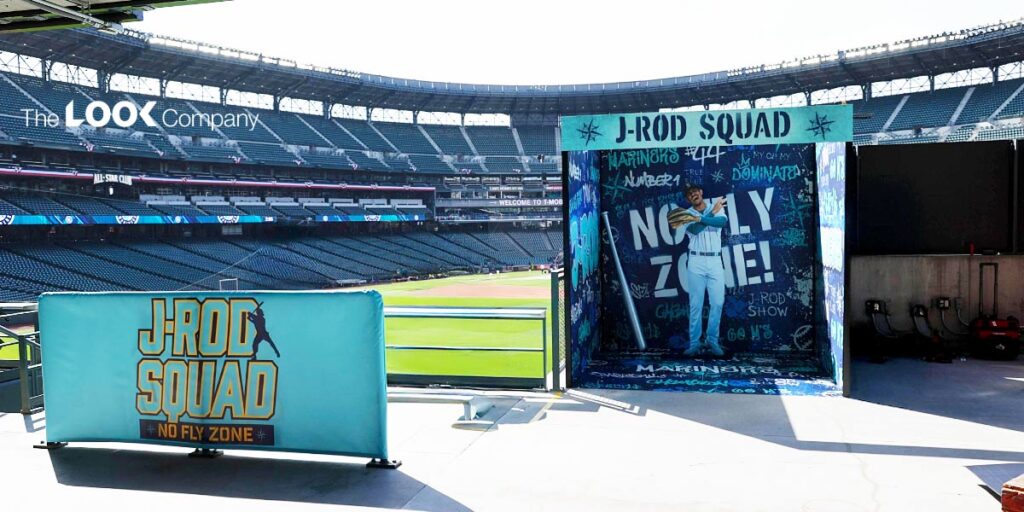
The Seattle Mariners’ branded section signs are a clear example: sponsor identities rotate across homestands without requiring a full rebuild between activations. Partnership teams that can offer sponsors a defined physical location with guaranteed visibility—without locking the venue into a permanent install—have stronger, more flexible inventory to sell.
Signs and banners engineered for repeated swap-outs reduce the risk of long-term installs that become liabilities when a deal changes scope or ends entirely.
Strategic takeaway: Flexible sponsor placements enable partnership teams to sell more inventory from the same physical space, increasing revenue without expanding the footprint.
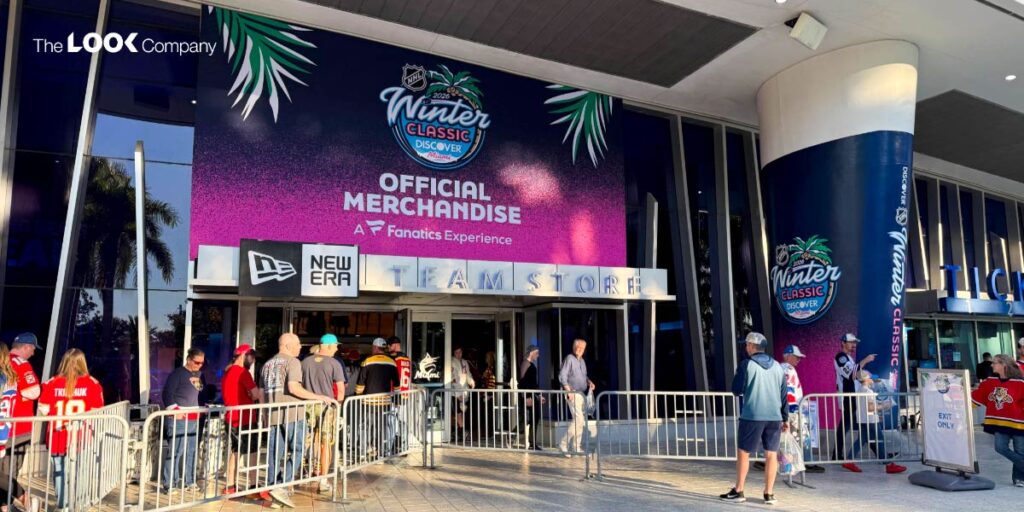
Made-for-Mobile Graphic Design: Visuals Engineered for the Phone, Not Just the Broadcast
The broadcast camera is no longer the primary lens through which fans experience in-venue graphics. Cellphones have taken over—and venues are redesigning accordingly, prioritizing bold typography, high-contrast color and cleaner compositions that read clearly on a 6-inch screen.
Made-for-mobile design—graphic compositions built to read clearly on a smartphone, using bolder type, higher contrast and simpler layouts than traditional broadcast-first design—is now a baseline expectation, not a differentiator.
Venues are also shifting who they design for. In-venue content creators and influencers are factored into graphic placement and composition decisions alongside broadcast camera angles.
Material choices are moving toward higher-contrast substrates and matte finishes that reduce phone glare. Layout decisions favor fewer elements per panel and more negative space, because graphics that don’t read on a phone miss the primary distribution channel for in-venue content.
Strategic takeaway: Evaluate existing graphic installations against mobile performance, not just broadcast standards. Prioritize updates to high-visibility locations where phone capture is most frequent.
Photo-Forward Environments: Vertical-First Layouts and Built-for-Social Moments
Beyond making existing graphics mobile-readable, venues are now building dedicated environments designed to be photographed—dimensional installations, themed concourse activations and mural walls that fans seek out and share.
The design logic is vertical-first: compositions built in portrait orientation to match how smartphone cameras are typically held and placed in high-traffic zones where fans naturally pause—gate entries, concourse corridors, tunnel approaches.
Every fan-shared image is branded content that the venue didn’t pay to distribute. Photo-op environments function as organic reach infrastructure, not decoration.
Branded photo moments also offer sponsors a high-engagement placement that fans actively seek out—distinct from static banners or boards.
Stadium fan engagement ideas that perform consistently include dimensional installations at high-dwell locations, concourse activations built around a visual anchor designed for portrait framing, and sponsor-integrated moments where brand identity is part of the composition from the start.
Strategic takeaway: Identify 2–3 high-traffic locations where a dedicated photo-forward installation would generate consistent organic content and design those environments with vertical framing and sponsor integration built in.
Immersive, Modular Fan Activations: Beyond Championship Events
CHAMPIONSHIP-SCALE PRODUCTION
The immersive fan villages and pop-up activations once reserved for Super Bowls and championship games are showing up at regular-season matchups. The 112th Grey Cup Championship in Winnipeg is a reference point—The Look Company delivered large-scale visual branding across Princess Auto Stadium, the Grey Cup Festival, the University of Winnipeg and the RBC Convention Centre, using printed fabric, vinyl and custom SEG graphics to transform multiple environments simultaneously.
Modular activation builds—temporary, reconfigurable structures with interchangeable graphic panels designed for repeated setup, changeover and breakdown—make that level of production viable outside championship windows.
COLLEGE AND RECURRING PROGRAM USE
Organizations are investing in graphic infrastructure that can flex week to week: themed concourse takeovers, large-format mural installations designed for short-run display, and roster recognition graphics updated each season.
For college programs, the ability to update environments annually is a recruiting tool. Draft board updates, championship recognition displays and recruiting-focused installations are among the highest-priority graphic investments at the athletic department level.
Strategic takeaway: Modular activation infrastructure is a capital investment. The upfront cost of reusable systems is recovered quickly compared to rebuilding for every event.
Inclusive Wayfinding: Beyond ADA Minimums
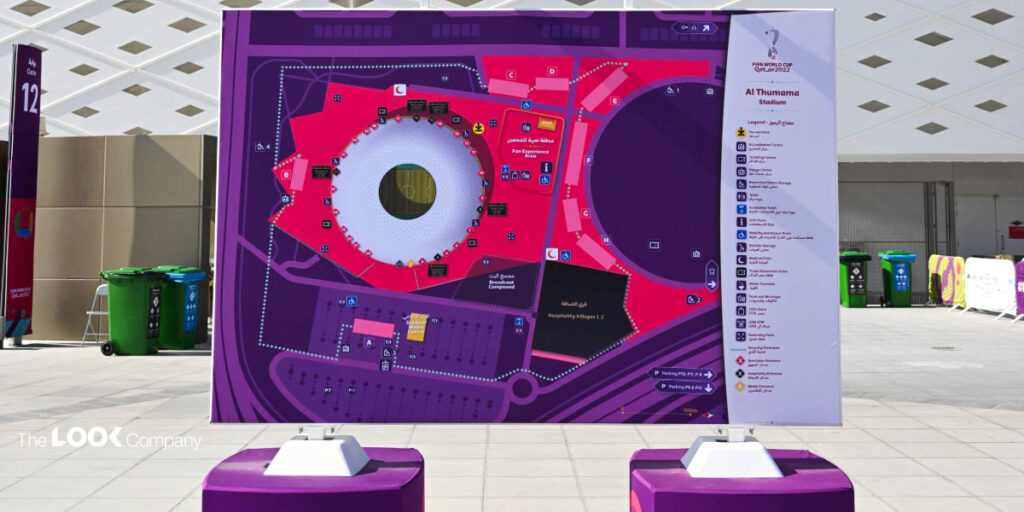
Venues are expanding their approach to navigation design beyond minimum ADA compliance to address a wider range of visitor needs—including neurodiverse guests, fans with visual or hearing impairments, non-English speakers and those managing temporary physical limitations.
Inclusive wayfinding—navigation design that works across a broad range of physical, sensory and cognitive differences, not just minimum legal requirements—now includes high-contrast icon-driven directional signage, color-coded concourse zones, sensory-friendly pathways (designated routes with reduced visual noise, lower foot traffic and clear signage for guests who experience sensory sensitivity) and multi-language graphic systems.
Poor wayfinding is an operations problem: it increases staff intervention, creates bottlenecks at gates and concourses and degrades the gameday experience for a growing segment of the audience.
Design systems now need to deliver clarity at eye level and overhead, from parking through to seating, with floor decals marking sensory-friendly routes and multi-language graphics at every primary decision point.
Strategic takeaway: Inclusive wayfinding is most cost-effective when designed into a refresh or new installation from the start—retrofitting it after the fact costs significantly more and rarely achieves the same clarity.
The Look Company: Designing Venues That Adapt
The graphic systems that make these sports branding trends operational—flexible fabric and frame installations, sponsor rotation hardware, large-format mural builds, modular activation environments—require a production and installation partner who understands how venues actually operate.
The Look Company manufactures, project manages and installs across North America, working with venue operators, athletic departments and sponsorship teams to build graphic infrastructure that performs at the speed the event schedule demands.
From dual-sport stadium changeouts to championship-scale festival branding, The Look Company is your one-stop shop that handles the production complexity so operators can focus on programming.
Explore how flexible graphic systems can support your venue—contact The Look Company to discuss your next project.
Or download our 2026 sports trends report for additional insights on fan engagement, sponsorship activation, venue branding and the emerging sports branding trends of 2026.